
Holyoke City Directory Holdings
The Holyoke Public Library collections make the History Room the primary local stop for historical directory work. The library holds early volumes for 1869 and 1873 through 1876, followed by a long run from 1882 through 1991. Those dates matter because an apparent gap may reflect the collection rather than a move. The local shelf also includes printed Holyoke street lists for 1986 through 2011, municipal registers, maps, newspapers, yearbooks, and family files. Use the directory run to identify a person or address, then use a second record type to test what the entry means.
| Collection | Years | Where Held | Access |
|---|---|---|---|
| Holyoke city directories | 1869; 1873-1876; 1882-1991 | Holyoke Public Library History Room | Reading Room; most digital for Holyoke cardholders |
| Holyoke street lists | 1986-2011 | History Room | Printed local list |
| Municipal registers | 1850-1968 | History Room | Annual town and city reports |
| Holyoke High School yearbooks | 1915-present | History Room | Local collection, with some earlier material |
| La Justice microfilm | 1909-1944 | History Room | French-language newspaper run |
The library collections page identifies the Holyoke directory, street-list, and local-history holdings.
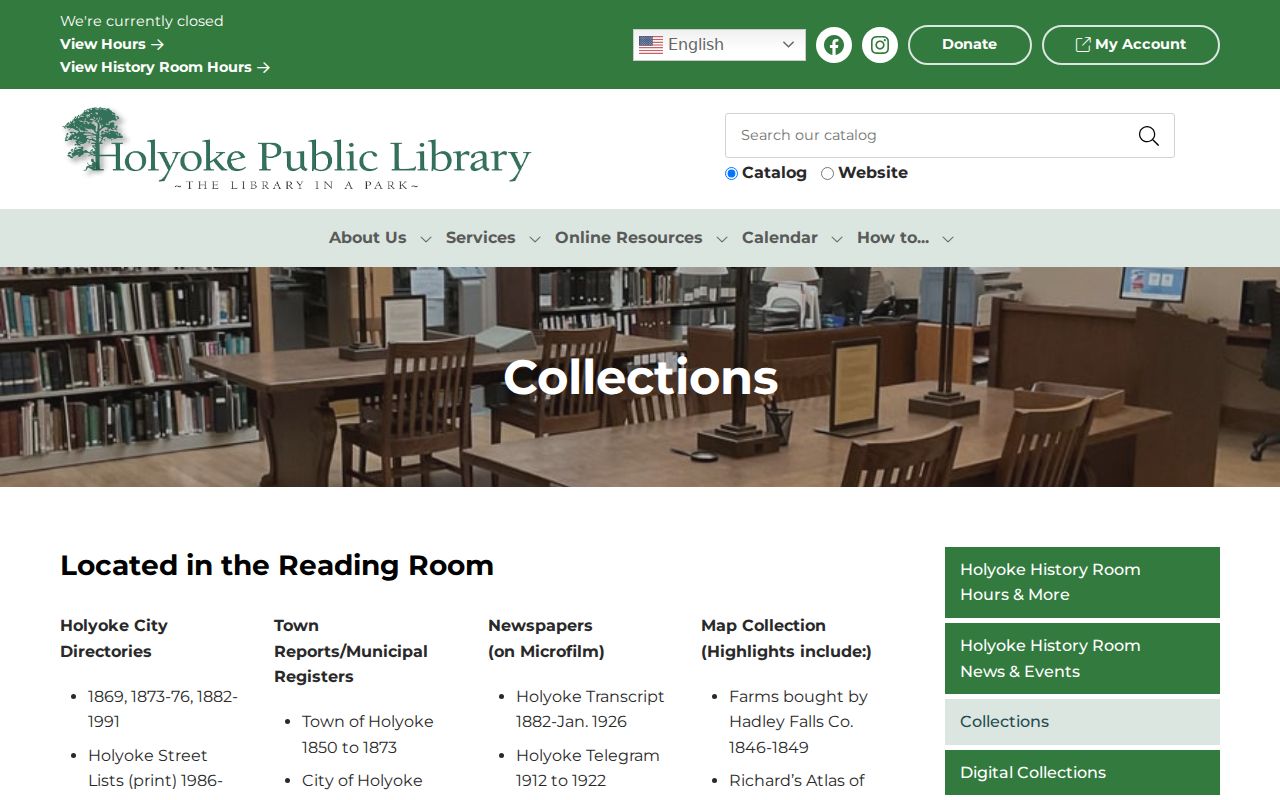
Seeing the collection description alongside the year runs helps separate a shelf gap from a gap in a household's record trail.
The Massachusetts State Library has complementary Holyoke volumes for 1879-1910, 1912-13, 1915-24, 1926-32, 1933-43, and selected later years. Its catalog is a planning aid, not a promise that every item is on open shelves. For a missing local year, check the State Library catalog and ask about current reading-room rules rather than assuming the volume was never printed.
Note: The library does not identify one publisher for every Holyoke volume, so title pages should be checked before assigning a publisher name to an entire run.
Holyoke History Room Access
The History Room is in the third-level gallery at Holyoke Public Library, 250 Chestnut Street. Listed regular Reading Room hours are Tuesday 10-2 and 3-6, Wednesday 10-4, and Thursday 10-4. The room is closed Monday and Friday except by appointment. Directories sit beside resources that help resolve a difficult entry: newspapers on microfilm, the 1895 Sanborn map, the 1911 Richard's Atlas, photographs, city reports, local biographies, and organization files.
Call ahead when the question depends on secure or archival material. Staff can help locate a run or explain the collection's access route, but an entry still needs to be read in its printed context. Record the volume year, page, spelling, and every abbreviation before leaving. That small citation trail makes it possible to revisit a name when a later census, deed, or obituary changes the interpretation.
See the library's History Room collections and access details before a research visit.
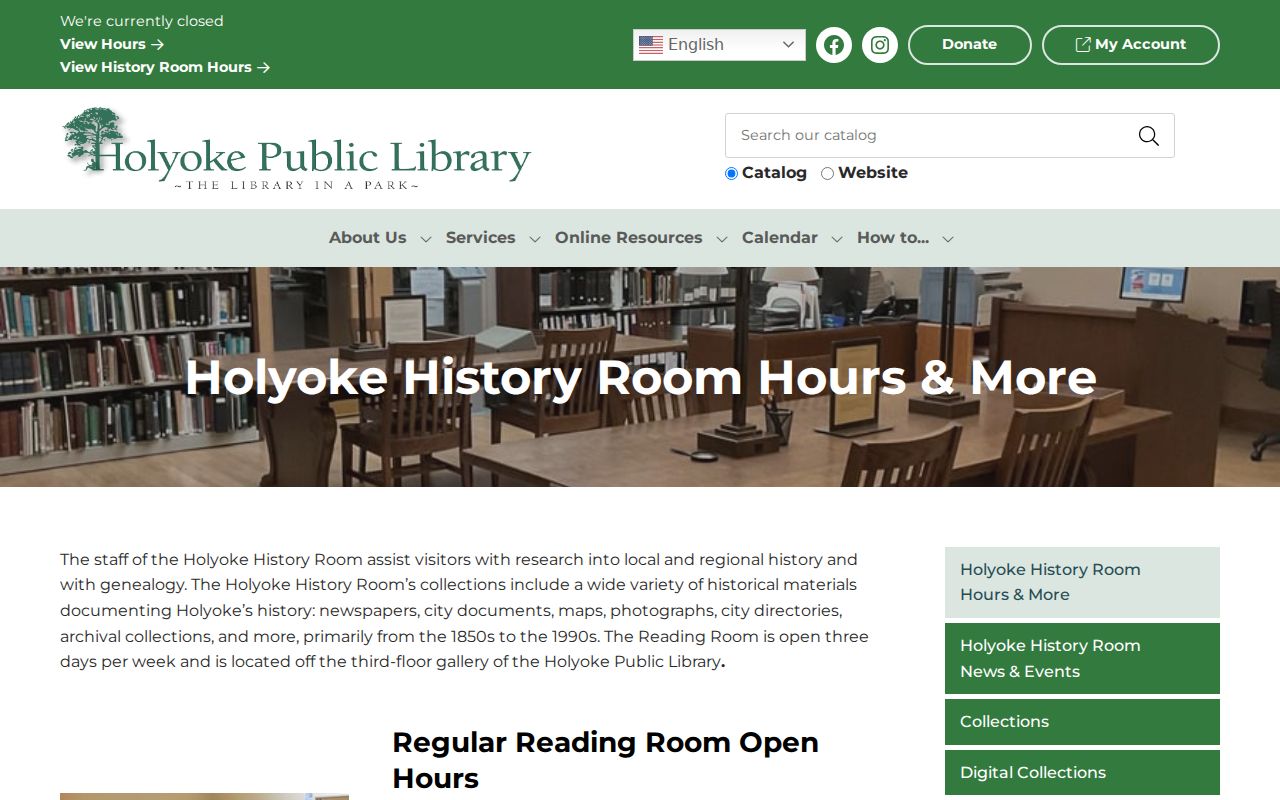
The History Room combines the directory shelf with maps and local publications, which is especially useful when one volume provides only an initial or an old street reference.
Holyoke Directory Access Myth
A common myth is that every Holyoke volume is open from every device. The library's Genealogy Resources page lists HeritageQuest for cardholders from home or for anyone using a library computer. Its broad collection includes federal census images through 1940 and directory volumes, though a particular Holyoke year depends on the scanned collection. The library restored HeritageQuest access for one year after funding changes, so current access should be checked before relying on a remote session.
Ancestry Library Edition and American Ancestors are available in the library. Ancestry can supply U.S. city-directory images where licensed; American Ancestors supports selected vital, military, probate, genealogical, and periodical research. Neither database replaces the local printed run, and each may omit a year or image. FamilySearch may also hold individual volumes, subject to its account and image-right rules.
Consult the library's genealogy database information before choosing a remote or in-library route.
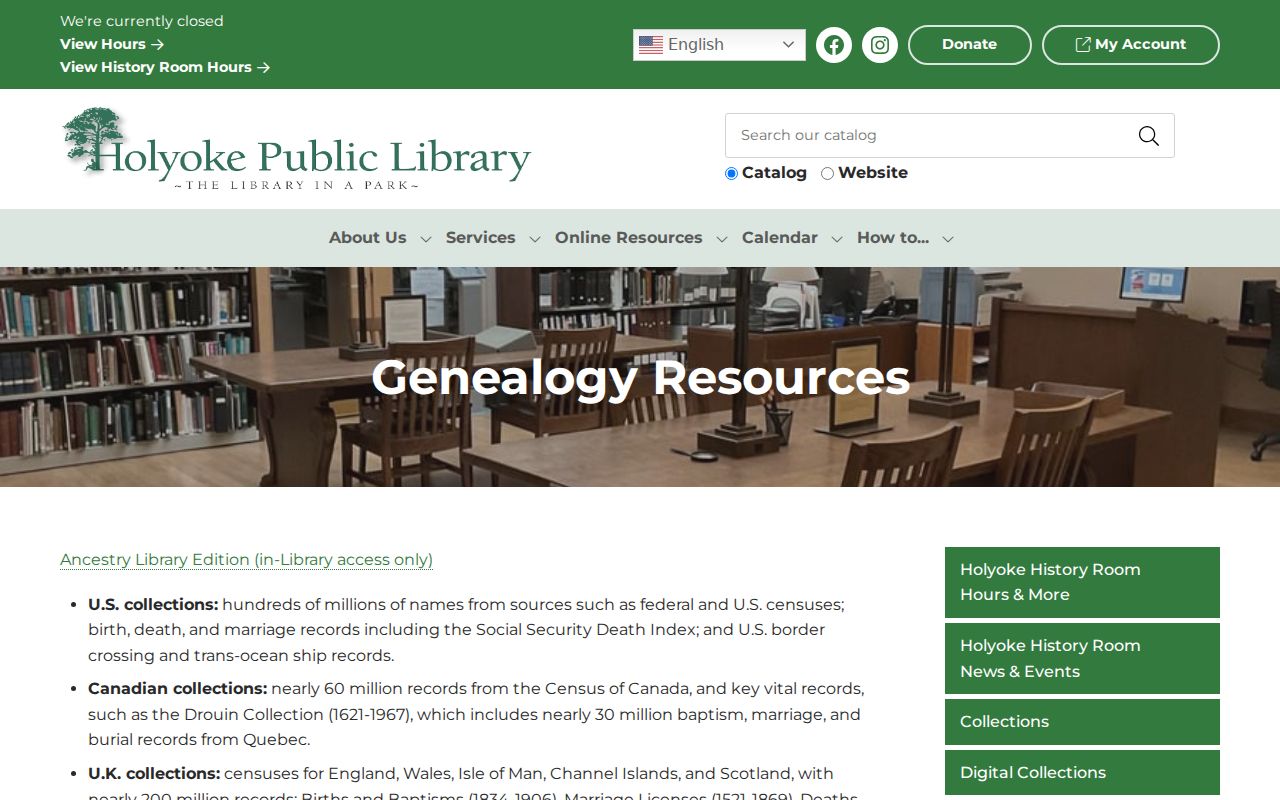
Digital images make year-to-year comparison faster, while the in-person collections remain the fallback when a needed volume or microfilm run is not remotely available.
Note: A database search result is an index lead, so open the page image and retain the volume year and page before treating it as evidence.
Reading Holyoke City Directory Entries
A Holyoke city directory often begins with an alphabetical name section and may include a street section, business listings, advertisements, and city-government pages. The name is usually printed surname first. An entry can add an occupation, employer or business connection, street address, household relation, or an abbreviated residence marker. These are clues printed for that edition, not a complete record of everyone at the address. Always find the abbreviation key and introductory material in the same volume before expanding a mark.
| Alphabetical name | Surname-first heading; initials and spelling variants can matter. |
|---|---|
| Household clue | A spouse or relation may follow the name, sometimes in parentheses. |
| Occupation | Work or business affiliation, when supplied in that volume. |
| Street address | House number and street, which can be checked in the street section. |
| Residence notation | Markers such as h., r., bds., or wid. must be read from the volume's key. |
| Business listing | Office or store address, firm or proprietor name, and sometimes telephone information. |
- Criss-cross directory
- A street-order listing that lets a reader start with an address and work back toward a printed occupant or business.
- Householder index
- An alphabetical finding aid organized around the person treated as the household entry in that edition.
- Abbreviation key
- The volume's own explanation of shortened labels such as residence, boards, widow, or initials; read it before making a modern translation.
Holyoke Street Lists and Registers
Printed directories are not the only name-and-address source in Holyoke. The History Room's street lists cover 1986 through 2011 and can be used as historical local-list material. Municipal registers extend from the Town of Holyoke years, 1850 through 1873, into City of Holyoke volumes from 1874 through 1968. Those annual reports can name officers, committee members, institutions, schools, public works contacts, businesses, and other civic participants. They add context that a compact directory entry may leave out.
These formats answer different questions. A street list may place a printed name at an address for its own date. A municipal register can tie a name to a city department, school, report, or institution. Neither establishes a current household, and a missing name can reflect the scope of the publication. Use the date printed on the item as the date of the observation.
For modern address-keyed records such as parcels and deeds, use the Holyoke by-street directory rather than stretching a historical list beyond its purpose.
Holyoke Directory Name Variants
Holyoke's industrial and migration history makes spelling part of the search. The library preserves French-language La Justice on microfilm for 1909 through 1944, and its collections include church material, yearbooks, obituaries, and local biographical files. A name that appears as initials in a directory may appear in fuller form in a school yearbook or newspaper notice. Search accents, French given names, Spanish surnames, married and maiden names, initials, and anglicized spellings without silently changing what the original printed.
One local spelling worth testing is “Sargeant.” The point is not to normalize it, but to compare the printed word against its exact street, page, map, or deed context. Newspapers can provide a move, marriage, club activity, obituary, or school reference, yet they remain secondary evidence. Pair a newspaper result with a directory, deed, vital record, or library-held source before treating it as a settled identity.
Note: Preserve the directory's original spelling in notes, then list each searched variant separately so a later researcher can reproduce the search.
Trace Holyoke City Directories by Year
For family history, begin with one confirmed year and work outward instead of jumping from a single directory directly to a broad conclusion. Start in the street section if the address is known, then locate the alphabetical entry in the same volume. Write down spelling, initials, relation wording, occupation, and address. Repeat in nearby volumes. The comparison can show a move, a change in household wording, or a shift from a home address to a business address, but it should not be treated as proof of an unprinted person's location.
- Find the first available Holyoke directory near the known address or name and note its exact year and page.
- Read the matching alphabetical and street entries, including the volume's abbreviation key.
- Check adjacent available years rather than assuming a missing volume means a household disappeared.
- Pair observations with the federal census years 1880, 1900, 1910, 1920, 1930, and 1940 through the library's genealogy access.
- Use an obituary, probate record, or later deed as a separate endpoint when a household leaves the listing.
Census records can show household relationships, ages, birthplaces, and an enumeration location. A directory can fill the years between censuses with an address and occupational or business clue. They should be read together, not merged into one claim.
Holyoke City Directory Map Timeline
Maps help a researcher decide whether two directory entries describe the same physical place. The History Room holds the verified 1895 Sanborn Map of Holyoke and Richard's Atlas of Holyoke from 1911. A street number can change, while a canal, mill, railroad, cross street, or building footprint may supply continuity. Read the map with the directory year and not as proof that a named person occupied the structure.
| 1850 | Holyoke became a town; municipal registers begin with the town-era series. |
|---|---|
| 1869 | Earliest verified Holyoke city directory held locally. |
| 1873 | Holyoke was incorporated as a city; local directories include 1873-1876 volumes. |
| 1882-1991 | Long local city-directory run in the History Room. |
| 1895 and 1911 | Verified Sanborn map and Richard's Atlas dates for resolving historic address context. |
Holyoke City Directory Limits
A printed volume is a dated publication, not a complete census or a current resident roll. It can omit children, lodgers, transient workers, people who declined listing, and some household members. A business address is not always a home address. An owner mark or a residence abbreviation belongs to the volume's own system and does not settle ownership, occupancy, or family relationship without another record.
Use the minimum information needed for family history, reconnecting with a relative, heir work, civic research, or historical curiosity. Avoid publishing full addresses or sensitive identifiers, and do not use a directory entry to harass, follow, or harm anyone. Protected addresses and restricted records remain subject to Massachusetts and custodian-specific rules.